
Carney Says Canada Could Turn to Chinese Automakers if Trump Talks Fail, Stresses That This Is Not Leverage but Physics
Speaking in Cambodia days before he meets Xi Jinping, Canada's prime minister said a Chinese auto partnership was "not leverage. But action, reaction." Our foreign correspondent consulted a textbook and a pigeon.

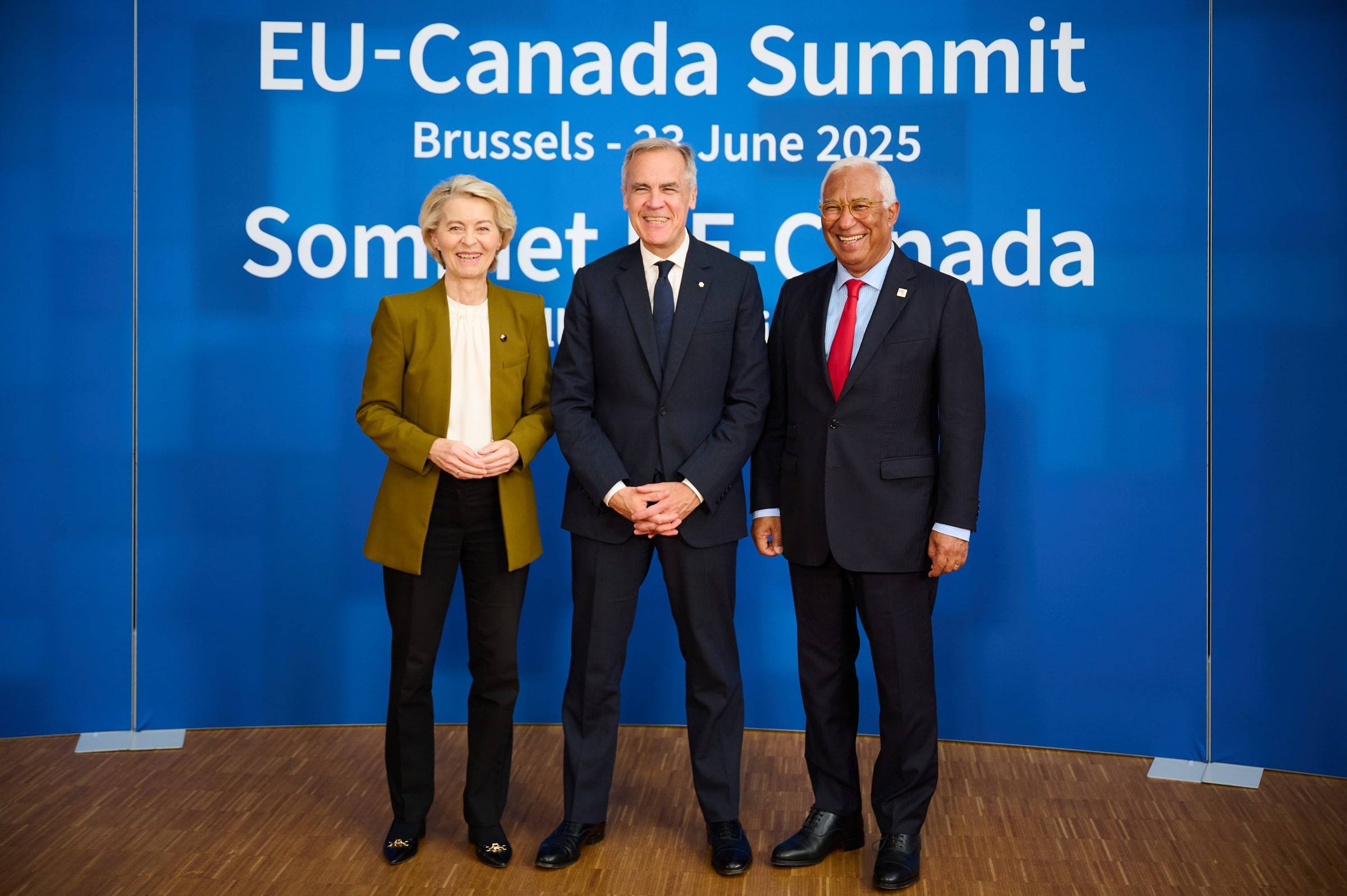
THE FOREIGN DESK (BASEMENT) — Canada could turn to Chinese automakers if its trade negotiations with President Donald Trump fail to preserve an integrated North American auto industry, Prime Minister Mark Carney said on Monday, and when reporters asked whether this was a threat, he gave the most diplomatic answer this correspondent has heard in years on the world desk. He cited physics.
“It’s not leverage,” Carney told reporters in Phnom Penh, Cambodia, according to the Associated Press. “But action, reaction.”
The prime minister was in Cambodia for the summit of French-speaking nations and is due to meet Chinese President Xi Jinping this week in Shenzhen, where Chinese auto manufacturing is expected to be discussed. Negotiations with the United States remain his priority, he said. Their outcome, he said, could decide whether Canada pursues alternatives involving European, Chinese or Japanese automakers.
“Canada is going to move forward either way,” he said.
A lesson in mechanics
For readers who did not take physics, or who took it in a basement, the principle is Newton’s third: for every action there is an equal and opposite reaction. It is not a threat. It is a law of the universe. Nobody has ever accused gravity of negotiating.
The action in this case is American. “We have the best auto workers in the world, and we want them fully deployed, full opportunity, in an integrated North American market,” Carney said. “That market has become less integrated because of U.S. trade actions.”
The Detroit Three, Ford, General Motors and Stellantis, run factories in Canada, the United States and Mexico, and parts sometimes cross the border several times before a vehicle is finished, the AP reported. Trump has repeatedly pushed automakers to move production from Canada to the United States. Stellantis recently shifted planned Jeep Compass production from Brampton, Ontario, to Illinois and agreed to sell its idle Canadian assembly plant, and Canada threatened to sue.
So a car part leaves Ontario, crosses into Michigan, comes back, crosses again, and now makes every trip under the shadow of American tariffs, which the AP reported have disrupted Canada’s auto industry. In that region, as in any marriage, it is possible to be integrated and keep score at the same time. The prime minister would like to keep the integration. The score-keeping, he suggests, is the action.
The reaction
The reaction has been in the works since January, when Carney and Xi reached an agreement that cut Canada’s 100 percent tariff on Chinese electric vehicles to 6.1 percent, initially for up to 49,000 vehicles a year, with the cap rising over time. China, in exchange, lowered its tariffs on Canadian farm products, canola among them. Chinese-made electric vehicles have since begun arriving in Canada.
Carney said at the time that he expected the deal to bring Chinese investment and jobs. On Monday he set terms. Any Chinese investment, he said, would have to involve real manufacturing in Canada, with proper labor standards, factories and domestic supply chains that grow over time, including Canadian critical minerals used in electric vehicles.
“It’s not just about kit cars,” he said. “There has to be a manufacturing aspect involved.”
This correspondent has assembled a kit car. It was a model of a 1962 Ford Galaxie, and it was assembled in the basement from imported parts. It has never been fully utilized in a North American context. It sits on the radiator, waiting for its own action, reaction.
Not everyone in Canada likes the formula. Ontario Premier Doug Ford, whose province is the center of the country’s auto industry, criticized the January deal and warned that Chinese electric vehicles could threaten Canadian jobs and put access to the American market at risk. The premier, it seems, has also read Newton. He simply fears the reaction more than the action.
The view from Manila
The talks with Washington are not dead. Over the weekend, in Manila, Carney said that he had spoken at length with Trump and senior American officials, that the two countries were making progress toward a possible agreement, and that differences remained. He has also said that any deal with Washington must leave Canada with a viable auto industry.
Thus the position of the Canadian government, as this desk understands it: talks are progressing, a deal is the priority, nothing is leverage, and the prime minister is flying to see the leader of the world’s largest car-exporting country later this week to discuss cars. This is not a bluff. It is a syllabus.
The pigeon abstains
This correspondent tested the principle at the basement window this morning. He tapped the glass. The pigeon on the ledge, his chief rival, moved six inches to the left. Action, reaction. He tapped again and the pigeon did not move at all, which this desk interprets as the pigeon securing a better offer elsewhere.
Peg Delacroix-Hume, the editor-in-chief, was asked whether the foreign desk might travel to Shenzhen to cover the meeting with Xi.
“This institution does not send correspondents to China to watch two men discuss cars,” she said. “He may cover it from his desk. That is not leverage. It is policy.”
The request has been returned. In that region and every other, an equal and opposite reaction is guaranteed. A travel budget is not.

More in World
World →
Trump, Putin and Xi Schedule Historic First Summit, Announce Its Outcome a Week Early
The White House has announced the first-ever meeting of the American, Russian and Chinese leaders, and a senior official has announced that it will…
Kim Jong Un Scraps North Korea's Soviet-Era Flag, and Our Man on the Ground Was Nearly 14 Hours Early to the Story
North Korea retired its Soviet-era flag by decree. Our world correspondent covered the redesign from the furthest-flung outpost of this newspaper —…

Spanish Prime Minister Urges Workers to Strike Over Housing Crisis, Which He Is in Charge Of
Spain's first general strike in 14 years had the unions calling it massive, business calling it low and the government cheering it on, so our…